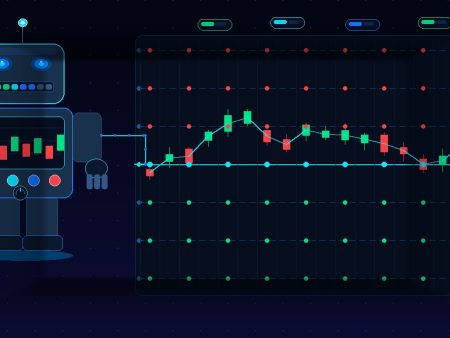
Stop-loss and take-profit levels define how a forex robot handles every trade from entry to close.


Stop-loss and take-profit levels define how a forex robot handles every trade from entry to close.

Stop-loss and take-profit settings define how a forex robot protects capital and locks in gains on every trade.
A forex robot can generate a perfect entry signal and still lose money consistently if its stop-loss and take-profit levels are poorly calibrated. The entry gets the robot into the market. The stop loss and take profit determine what happens next, whether a winning trade reaches its target, whether a losing trade stays within acceptable limits, and whether the strategy’s overall risk-to-reward ratio produces a positive expectancy over time. These two parameters work together as the trade management foundation of every forex robot, and their design deserves as much scrutiny as the entry logic that triggers the position in the first place.
Most traders evaluate a robot’s win rate and net profit without examining the stop loss and take profit distances that produced those numbers. A strategy showing an 80% win rate might achieve that figure by placing a very wide stop loss and a very tight take profit on every trade, meaning the few losing trades are catastrophically large relative to the small, frequent winners. Understanding how a robot’s stop and target levels interact with its win rate gives traders a far more complete picture of whether the strategy carries a genuine edge or simply disguises a poor risk-to-reward structure behind an impressive headline statistic.
A stop loss is a predefined price level at which the robot automatically closes a losing trade to prevent further loss. Once a forex robot opens a position, the stop loss sits on the broker’s server as a standing instruction. If price reaches that level, the broker closes the trade immediately at the best available price, regardless of whether the robot is actively monitoring the account at that moment.
This server-side placement is particularly important for automated traders running robots on a VPS. Even if the VPS experiences a temporary interruption, the stop loss already placed on the broker’s server continues to protect the open position. A robot that relies solely on virtual stop losses managed internally by the EA software rather than placed on the broker’s server loses that protection during any connectivity gap, because the stop only triggers if the EA is running and able to send the close instruction. Consequently, most well-designed EAs place hard stop losses on the broker’s server immediately upon trade entry, treating virtual stops as supplementary rather than as the primary protection mechanism.
A take profit is a predefined price level at which the robot automatically closes a winning trade and locks in the gain. Like the stop loss, the take profit sits on the broker’s server after placement, which means it triggers reliably even without the EA actively running at that exact moment. The take profit level defines the maximum gain the robot collects from any individual trade, and its distance from the entry price directly determines the trade’s risk-to-reward ratio when combined with the stop loss distance.
Setting the take profit at a level the market realistically reaches, based on the pair’s average daily range and the timeframe being traded, is central to how frequently the target actually fills. A take profit placed too far from the entry price produces a theoretically attractive risk-to-reward ratio on paper but results in a low win rate in practice, since price rarely travels that far in the intended direction before reversing. Conversely, a take profit placed too close to the entry reduces the risk-to-reward ratio to a level where the strategy needs an unrealistically high win rate just to break even after spread costs. Therefore, calibrating takes profit distance to the pair’s actual volatility and the robot’s historical win rate together produces the most balanced and sustainable configuration.
The risk-to-reward ratio compares the distance between entry and stop loss against the distance between entry and take profit. A robot risking 20 pips to gain 40 pips operates at a 1:2 risk-to-reward ratio. This ratio interacts directly with the strategy’s win rate to determine whether the robot produces a positive expectancy, meaning whether it makes money over a statistically significant sample of trades.
A strategy with a 1:2 risk-to-reward ratio only needs to win more than one in three trades to produce a positive expectancy before costs. By contrast, a strategy with a 1:0.5 risk-to-reward ratio, risking 40 pips to gain 20 pips, needs to win more than two in three trades just to break even. Many forex robots marketed with high win rates operate with exactly this inverted structure, where the few losses vastly outweigh the many small wins. Traders who check only the win rate percentage without examining the underlying risk-to-reward ratio cannot accurately assess whether a robot’s historical performance reflects a genuine positive expectancy or a mathematical illusion.
Furthermore, spread costs affect the realised risk-to-reward ratio on every trade. A robot targeting a 10-pip take profit on a pair with a 1.2-pip spread collects only 8.8 pips net on each winner, while paying the full stop loss distance on each loser. This asymmetry erodes the strategy’s effective risk-to-reward ratio below what the raw pip distances suggest, particularly for short-term scalping robots targeting small gains on each trade.
Forex robots use two broad approaches to stop loss and take profit placement. Fixed placement sets both levels at a defined pip distance from the entry price on every trade, regardless of current market conditions. Dynamic placement calculates both levels based on real-time market data, most commonly the Average True Range, known as ATR, so that the stop and target automatically widen during volatile periods and tighten during calm ones.
Fixed placement offers simplicity and predictability. Traders know exactly how many pips the robot risks and targets on each trade, which makes the risk-to-reward ratio straightforward to evaluate. The limitation is that a fixed pip distance does not account for the fact that a 20-pip move on EUR/USD during a calm Asian session represents a very different proportion of typical price movement than the same 20-pip move during the London-New York overlap. A stop that sits comfortably outside normal price fluctuation during quiet hours may sit well within the range of normal intraday noise during active sessions, resulting in premature stop-outs on otherwise valid setups.
Dynamic ATR-based placement solves this problem by scaling the stop loss and taking profit to current volatility. During high-volatility sessions, the robot automatically places wider stops that give trades more room to breathe without triggering prematurely. During low-volatility conditions, both levels tighten proportionally, keeping the risk-to-reward ratio consistent even as absolute pip distances change. Consequently, ATR-based robots tend to show more stable performance across varied market conditions than their fixed-distance counterparts, particularly on pairs and sessions where volatility fluctuates significantly throughout the day.
A trailing stop moves the stop loss automatically in the direction of a profitable trade, locking in gains as price advances while still giving the position room to continue running. Once a trade moves a defined number of pips into profit, the trailing stop activates and follows price at a fixed distance. If the market reverses by that distance, the trade closes automatically at a profit rather than waiting for the original take profit level to fill.
Trailing stops suit trend-following forex robots that aim to capture extended directional moves. Rather than exiting at a fixed take profit that may leave substantial additional gains on the table during a strong trend, the trailing stop allows the robot to ride the move further while protecting a portion of the accumulated profit. The trade-off is that trailing stops produce more variable exit prices than fixed take profit levels, which makes the strategy’s historical performance less uniform in appearance even when the underlying edge remains strong.
Partial close strategies represent a middle approach. The robot closes a portion of the position typically half at a fixed take profit level, then moves the stop loss to breakeven on the remaining portion and either sets a wider take profit or applies a trailing stop to the remainder. This approach secures a guaranteed partial gain on each winning trade while preserving exposure to larger moves on the rest of the position. Additionally, moving the stop to breakeven on the remaining portion eliminates downside risk on that part of the trade entirely, which reduces the psychological and financial impact of a reversal after the initial target has already been filled.
Stop loss and take profit placement defines the risk-to-reward structure of every trade a forex robot executes, and that structure determines whether the strategy produces a positive expectancy over time regardless of its win rate. A robot whose stop and target levels are calibrated to realistic market volatility, placed as hard orders on the broker’s server, and aligned to produce a genuine positive expectancy across its historical trade sample gives traders a far more reliable foundation than one whose headline statistics obscure an unfavourable underlying structure.
Evaluating stop loss and take profit design alongside entry logic, backtest quality, and money management approach produces the most complete assessment of any EA a trader considers. These two parameters do not attract the same attention as win rates and equity curves in most robot marketing materials, but they shape every single trade outcome the robot produces from the moment it enters the market to the moment it exits.
Also, take a look at the Reviews we have prepared for you!